
Introduction: The Next Evolution of AI Conversations
For years, chatbots have been able to answer questions, generate ideas, and perform tasks. But they all shared one limitation: they reacted. They didn’t truly understand. They lacked the ability to connect ideas, remember context at scale, or reason across complex topics.
That changes with ChatGPT Atlas.
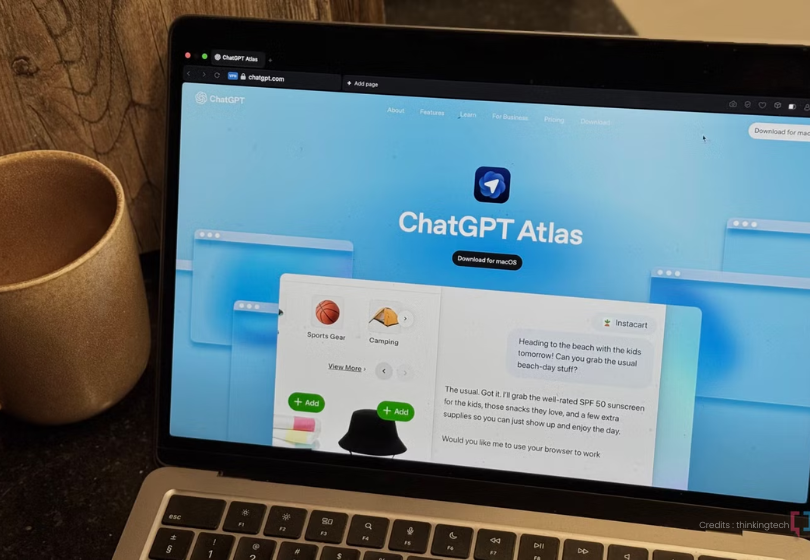
ChatGPT Atlas represents a major leap in conversational intelligence, allowing users to explore information like navigating a map, not just receiving answers. This new model acts less like a chatbot and more like a knowledge navigator—one that understands your intent, remembers context, and collaborates to reach deeper insights.
Whether you’re a researcher handling massive information loads, a business optimizing workflows, or a creator brainstorming big ideas, Atlas brings a level of intelligence that transforms how humans and AI work together.

What Is ChatGPT Atlas?
ChatGPT Atlas is OpenAI’s latest advanced conversational AI system, built to traverse and connect vast knowledge domains. Unlike earlier models that operated on a question-and-answer pattern, Atlas interprets relationships between ideas, forms semantic understanding, and adapts to complex reasoning tasks.
Think of previous AI models as encyclopedias.
Atlas is the navigator that guides you through them.
What makes Atlas different?
Atlas is built to:
- Maintain long-term contextual memory
- Interpret layered or ambiguous questions
- Navigate topics using knowledge mapping
- Assist across multidisciplinary workflows
It isn’t just responding.
It’s thinking with you.
Key Features That Make ChatGPT Atlas Revolutionary
Extended Memory and Contextual Navigation
Atlas can sustain conversations over hours or days, recalling prior interactions and building on them. It tracks goals, references earlier details, and adapts as conversations evolve.
Example:
If you say on Monday, “I’m working on a research paper about cybersecurity,” Atlas can reference that on Thursday and provide relevant sources without starting over.
Semantic Knowledge Mapping
Instead of providing isolated answers, Atlas builds conceptual maps that show how ideas connect.
This enables users to:
- Explore related concepts
- Follow different angles of a topic
- Uncover insights faster
It transforms learning from linear to exploratory.
Multimodal Comprehension
Atlas integrates text, images, and audio, supporting workflows like:
- Reviewing charts and visuals
- Analyzing documents or handwritten notes
- Understanding voice prompts
This makes collaboration more natural and multi-sensory.
Dynamic Reasoning and Query Refinement
Instead of giving generic answers, Atlas:
- Asks clarifying questions
- Suggests more precise directions
- Offers multiple interpretations of complex queries
It is a conversation partner that thinks with you, not for you.
Domain Customization
ChatGPT Atlas can integrate proprietary datasets, giving organizations private, domain-specific expertise.
Industries benefiting from this include:
- Finance
- Education
- Medicine
- Legal services
This positions Atlas as a customizable AI knowledge assistant.
How ChatGPT Atlas Changes AI Interaction
With Atlas, AI becomes a true collaborator.
For Researchers
Atlas can summarize research, extract insights, and create hypothesis paths by connecting related studies.
For Developers
Atlas identifies bugs, explains code behavior, and suggests optimizations in context.
For Educators
Atlas adapts to student learning styles and builds personalized learning paths.
For Businesses
Atlas enhances support systems with nuanced, adaptive dialogue instead of canned responses.
This transforms productivity, research depth, and collaboration speed.
Why ChatGPT Atlas Matters for the Future of Conversational Intelligence
Atlas represents a shift in what AI can be.
Instead of:
- Answering questions
- Producing output on request
Atlas becomes a co-reasoner—able to explore, interpret, and navigate knowledge alongside the user.
This evolution signals a future where conversational AI becomes a standard component of tasks involving:
- Research and discovery
- Decision-making
- Innovation and ideation
Atlas enhances human intelligence rather than replacing it.
Conclusion: ChatGPT Atlas and the New Era of AI Navigation
ChatGPT Atlas is not just a smarter chatbot.
It is a new category of AI: a conversational navigator.
By combining memory, reasoning, multimodal inputs, and semantic mapping, Atlas elevates how we learn, work, and think. It shifts AI from passive responder to active collaborator—helping users explore ideas with depth and agility.
The future of AI is not simply answering questions.
It is navigating knowledge.
ChatGPT Atlas marks the beginning of that future.
FAQs About ChatGPT Atlas
Q1: What is the main difference between ChatGPT Atlas and previous models?
Atlas uses semantic navigation and contextual memory to explore topics deeply rather than answering in isolated fragments.
Q2: Can ChatGPT Atlas handle long-form or multi-day conversations?
Yes. Atlas is designed to retain context over extended conversations and reference past details.
Q3: Does Atlas support multimodal inputs?
Yes. It can interpret text, images, and audio, enabling richer interaction.
Q4: Can businesses customize Atlas with internal data?
Yes. Atlas allows domain-specific augmentation for industries such as legal, finance, and research.
Q5: How does Atlas improve conversational intelligence?
It refines user queries, asks clarifying questions, and uses knowledge mapping to collaboratively explore topics.














No Comments